

Not Every Creator Scandal Is a Brand Crisis. Stop Reacting Like It Is.

A creator scandal doesn't automatically have to become a brand crisis. The real cost often comes from how the brand reacts.
The first mistake brands make during a creator crisis is treating every controversy like the same crisis.
An old tweet, an offensive statement, a personal dispute, a criminal allegation, a product-related mistake, and a creator simply being “cancelled” by the internet are not the same thing.
Yet brands often respond with the same playbook: Pause everything → delete everything → terminate creator → issue statement → lose campaign investment.
Sometimes that's absolutely the right decision. But sometimes it's an unnecessarily expensive one.
1. STOP — Don't let the internet decide for you
Before anyone drafts a statement:
What actually happened?
Is the information verified?
Is the creator directly responsible?
Is the controversy connected to the brand?
Is branded content currently live?
Is paid media running?
Are other creators involved?
Has the creator responded?
Is the conversation growing or already declining?
The goal isn't to “win” the internet.
It's to understand the situation before spending money responding to it.
2. SEPARATE — Creator problem vs. brand problem
Ask:
Is the creator in trouble, or is the brand actually being pulled into the trouble?
There is a huge difference.
For example:
Scenario A:
A creator makes an unrelated controversial statement on their personal account.Scenario B:
The creator's controversial behavior happens while promoting the brand.Scenario C:
The creator says something that directly contradicts the brand's values.Scenario D:
The creator's campaign content itself contains the problematic message.The further you move from A → D, the greater the potential brand exposure.
So don't immediately ask:
“Do we fire the creator?”
Ask:
“Where exactly is the brand exposure?”

3. PAUSE — Stop the money before you stop the relationship
If you're running:
Partnership Ads
whitelisted content
paid amplification
scheduled creator posts
retargeting
boosted content
affiliate campaigns
Pause the financial amplification first.
You don't necessarily need to terminate everything immediately.
You need to stop additional exposure and additional spend while the situation is being assessed. This distinction is important because a creator scandal can become considerably more expensive when the brand continues actively distributing the creator's content.
So: Pause the media before you panic about the partnership.
4. ASSESS — Use a crisis matrix
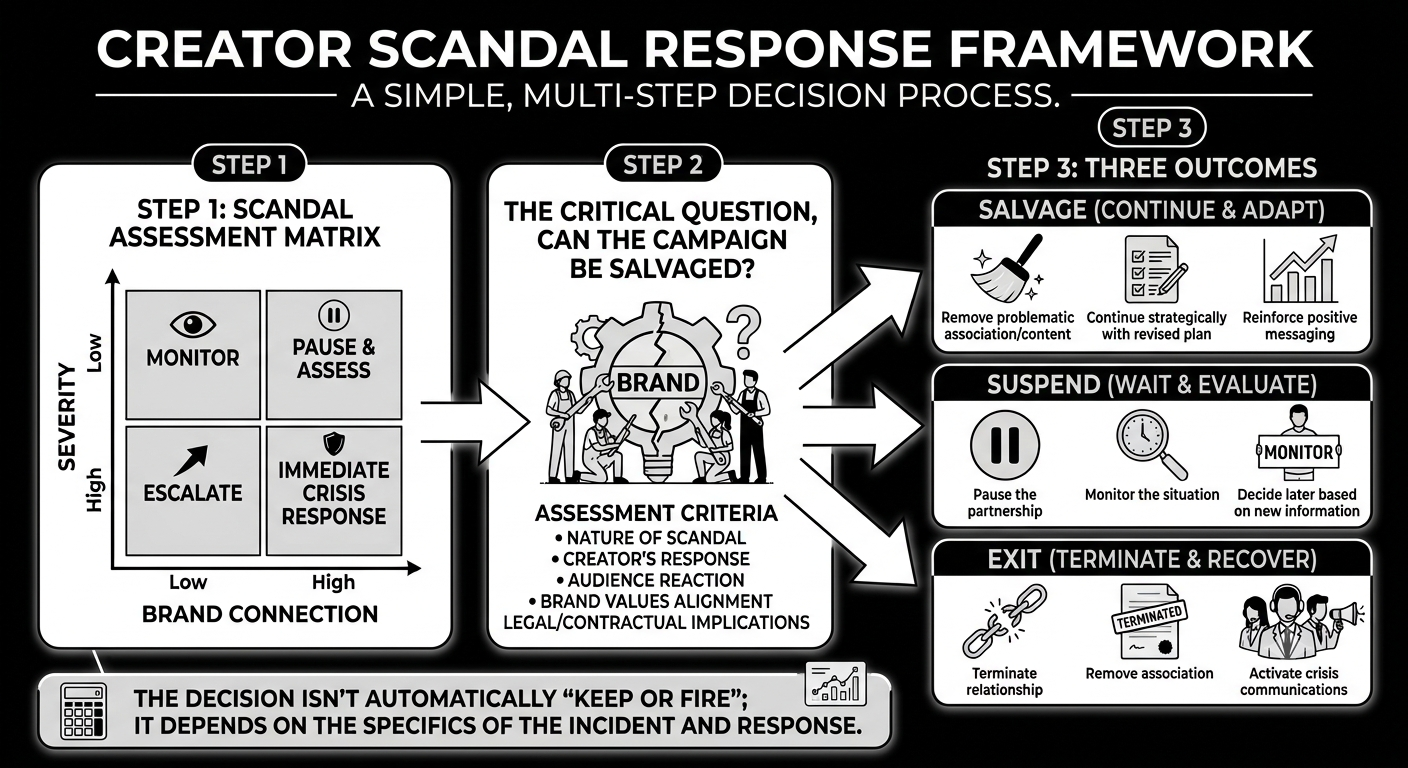
Then add a second question:
Can the campaign be salvaged?
Because there are actually three possible outcomes:
SALVAGE
Remove problematic association/content → continue strategically.SUSPEND
Pause the partnership → monitor → decide later.EXIT
Terminate relationship → remove association → activate crisis communications.
5. PROTECT — Don't throw away assets you've already paid for
Imagine a brand has already invested:
$100K creator production
$50K media
agency fees
content localization
production resources
launch planning
Then a creator controversy happens.
The instinct might be:
“Kill the entire campaign.”
But what if the creator's face can be removed?
What if the content can be edited?
What if the campaign narrative can continue through other creators?
What if the brand can stop the problematic asset while keeping the broader campaign alive?
What if unused media budget can be redirected?
Crisis management shouldn't automatically mean campaign destruction. Sometimes it means isolating the damaged component.
That's a very important distinction.
6. REDIRECT — Build a Plan B before you need it
If your entire campaign depends on one creator, your system is fragile.
But if you've built:
Creator A → Awareness
Creator B → Consideration
Creator C → Expertise
Creator D → Community
Creator E → Conversion
then losing one creator doesn't necessarily kill the campaign. You can reallocate the role.
7. The money question: What will actually cost the brand more?
There are potentially three costs:
Cost 1 — Staying
You continue associating with the creator and risk reputational damage.
Cost 2 — Leaving
You terminate the relationship, potentially lose production/media investment, deal with contractual consequences, and rebuild the campaign.
Cost 3 — Overreacting
You abandon assets, pause unrelated creators, kill the entire campaign, and spend again rebuilding something that didn't actually need to be destroyed.
The third cost is often forgotten. Crisis management isn't about minimizing the noise. It's about minimizing unnecessary business damage.
8. The contract is important — but it's not the strategy
I'd definitely include morality clauses, termination rights, usage rights, takedown obligations, payment terms, and potentially clawbacks. But don't make the article too legal.
Your POV should be:
A morality clause tells you what you can do. It doesn't tell you what you should do.
Recent industry coverage shows brands increasingly relying on morality clauses as an exit mechanism when creators become liabilities. But the strategic decision still requires judgment.
Legal tells you:
“Can we terminate?”
Marketing asks:
“Should we?”
PR asks:
“How will this affect perception?”
Finance asks:
“What does this cost?”
And the business leader needs to connect all four.

To recap, at J.Z Private Consulting, we follow this framework:
STOP → SEPARATE → PAUSE → ASSESS → PROTECT → REDIRECT
To:
STOP THE NOISE.
PROTECT THE BUSINESS.
PRESERVE THE OPTIONS.
A creator crisis shouldn't force a brand into an immediate binary decision between “do nothing” and “cut ties.”
The smartest response is often the one that creates enough space to make the right decision without creating unnecessary financial damage.
J.Z Private Consulting
Professional. Precise. Progress.
