

Your Influencer Campaign Doesn’t Need More Creators. It Needs Better Roles.

Stop Choosing Influencers by Follower Count. Start Choosing Them by Role.
A creator’s value isn’t defined by how many followers they have, but by what they can make those followers do, feel, understand, or talk about.
1. The bigger isn't always better
Start with the familiar pitch:
“We need 20 creators.”
“Can we get more macro influencers?”
“This creator has 2 million followers.”
“What about their engagement rate?”
The problem isn't that these metrics are useless.
The problem is when they become the strategy.
A campaign can have 50 creators and still create less meaningful impact than one carefully selected creator who has a clear role within the campaign.
2. Follower count tells you scale. It doesn't tell you influence.
Followers can tell us approximately how large someone's audience is.
But they don't necessarily tell us:
Why people follow them
What their audience trusts them for
What conversations they influence
What type of content their audience responds to
Whether they can create consideration, action, or advocacy
Whether their audience actually overlaps with the brand's objective
A creator with 100K highly relevant followers can sometimes contribute more strategically than a creator with 2M followers who has little relevance to the campaign.
So instead of asking:
“How big is this creator?”
Ask:
“What can this creator uniquely contribute?”

3. The real problem: campaigns often don't give creators a role
Many influencer campaigns are built like:
Brand → Message → Creator → Content → Reach
But a stronger approach is:
Business Objective → Consumer Journey → Creator Role → Content → Conversation → Outcome
The creator shouldn't simply be another person distributing the same campaign message.
They should have a purpose within the campaign ecosystem.
For example:
One creator creates cultural awareness
One makes the product relevant to a specific lifestyle
One provides expert authority
One creates relatability
One drives product consideration
One generates peer validation
One creates conversation and community
Now you're not just buying creators.
You're designing a creator ecosystem.
4. Different creators. Different jobs.
Mega / Macro
Cultural visibility & mass awareness
Mid / Micro
Relevance & community engagement
Nano / KOC
Relatability & peer validation
KOL / Expert
Authority & education
Content Creator
Storytelling & cultural relevance
Niche Creator
Specific audience connection
Community Creator
Conversation & advocacy
And importantly: These aren't fixed rules.
A micro creator can create awareness.
A macro creator can drive consideration.
A KOC can create a cultural moment.
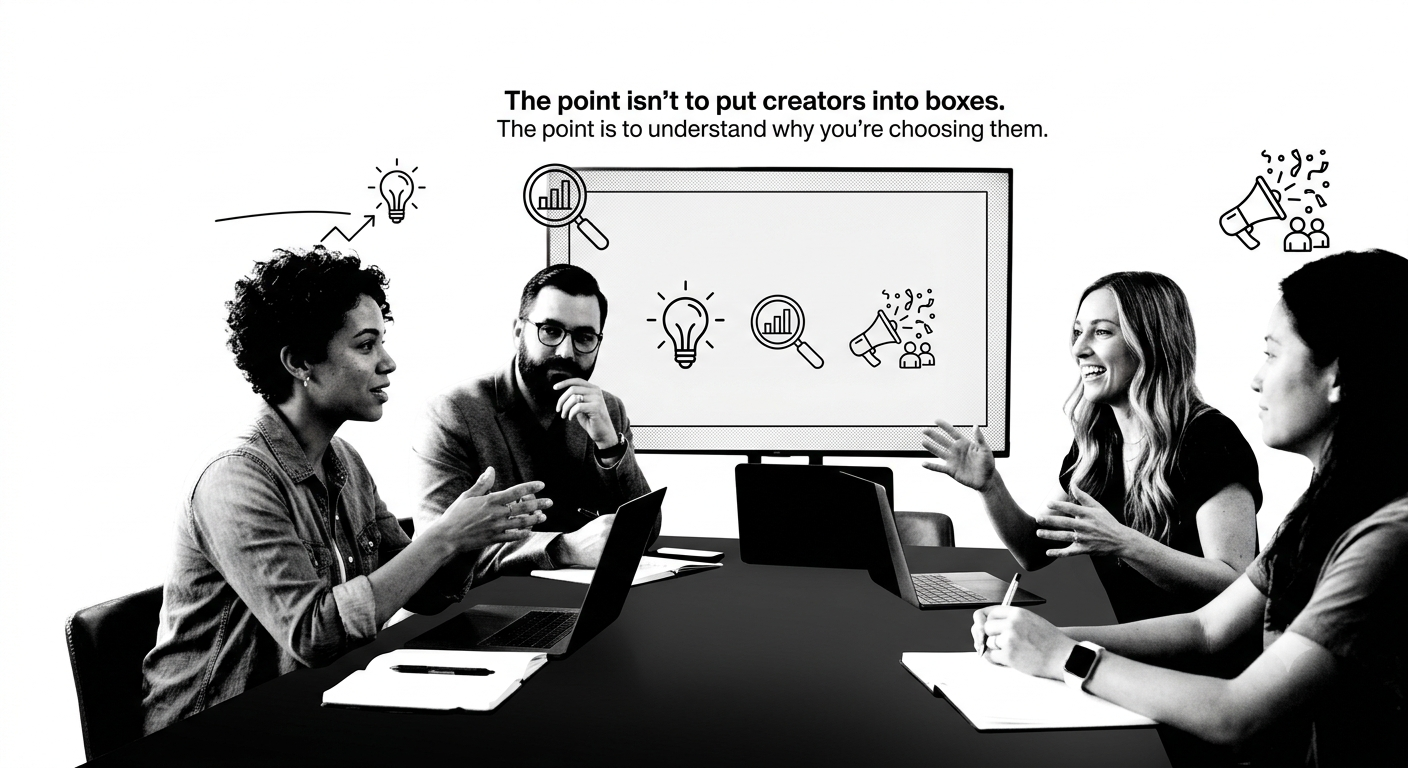
The point isn't to put creators into boxes.
The point is to understand why you're choosing them.
5. One campaign doesn't need one type of influence
Instead of expecting every creator to perform the same function:
One Brand Truth
↓
Different Creator Roles
↓
Different Interpretations
↓
Different Consumer Moments
↓
One Larger Brand Conversation
That's much more powerful than asking 30 creators to produce 30 slightly different versions of the same branded post.
You're allowing the campaign to exist in different parts of people's lives.
6. The question brands should be asking
Instead of:
“How many followers does this creator have?”
Ask:
“What role does this creator play?”
Then:
“Why is their audience the right audience for that role?”
And finally:
“What do we expect to happen because this creator is part of the campaign?”
That changes influencer selection from a talent-shopping exercise into a strategic decision.

At J.Z Private Consulting, we don't look at creators simply as talent to be booked or media inventory to be purchased.
We look at the relationship between brand objectives, consumer behavior, creator influence, and the role each partnership can play.
Because sometimes, your campaign doesn't need more creators.
It just needs better reasons for having them.
J.Z Private Consulting
Professional. Precise. Progress.
